Most contractors I talk to know they carry a tool floater. Far fewer have read what it says, which is fair, since nobody reads a policy wording for fun. With this coverage the conditions matter as much as the limit, and a few minutes with the wording now can save you a very unpleasant conversation with an adjuster later.
A tool floater covers your tools wherever they happen to be, so a drill in the truck or a saw on a job site is covered the same as one on the shelf in your shop.
Start with the limit on any one item. Most tool floaters cap what they pay for any one item, pair or set that is not individually listed on the policy. $2,500 is common, though I have read wordings capped at $1,000, so the number on your own policy is the one that counts. If an unlisted rotary laser worth $6,000 is stolen under a $2,500 cap, $3,500 of that loss is yours ($6,000 minus $2,500) before the deductible even comes into it. Anything worth more than the cap should be scheduled, meaning listed on the policy by itself with its own value.
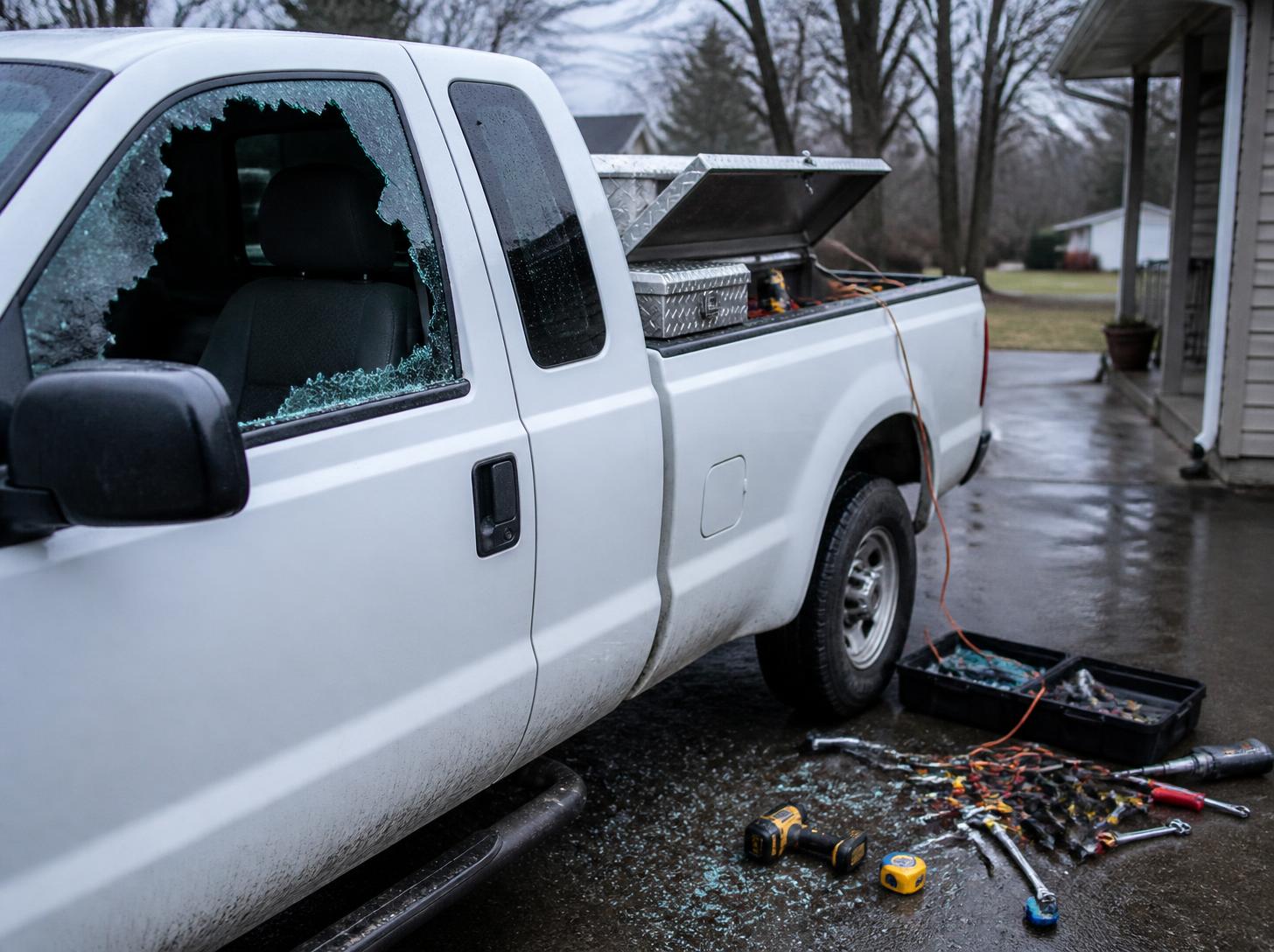
The condition that catches the most people is the locked vehicle warranty, sometimes written as a locked compartment condition. A warranty in insurance is a promise that a condition will be met, and if it is not, coverage for that loss may not respond. A typical wording covers theft from an unattended vehicle only as a direct result of forcible entry into a fully enclosed metal body or compartment, with the doors securely locked and the windows closed, and some wordings also want visible evidence of the forced entry. Tools under a soft tonneau cover or in a plastic deck box are not in a locked metal compartment, and neither is a truck left unlocked while you run into the supplier. A locked steel job box secured in the bed is much closer to what the wording asks for.
Then there is how a loss is valued. Actual cash value, or ACV, is the cost to replace the tool today less depreciation for age and wear, while replacement cost pays for the equivalent new with nothing taken off. Many tool floaters settle on ACV unless replacement cost has been added, and where it is offered it is often limited to tools under a certain age, commonly three or five years in the wordings I see. If a five-year-old compressor would cost $1,200 to replace and the adjuster depreciates it by half, ACV pays $600 ($1,200 x 50%) before your deductible, and across a truck full of older tools that gap adds up.
The last piece is the easiest. Keep a basic spreadsheet of your tools with the make, model, serial number, purchase date and price, and keep the receipts together in one folder or email label. Even a date and time stamped photo of each tool when you buy it helps. At claim time you will be asked to show what you had and what it was worth, and a list rebuilt from memory after a break-in rarely captures everything.
Reading a policy wording should not be a job you do alone. When a tool floater is placed or renewed, a broker should walk you through conditions like the per-item limit and the locked vehicle warranty, and asks how you actually store and move your tools so the coverage matches the way you work. If nobody has had that conversation with you yet, it is a fair thing to ask for. And if you would like a second set of eyes, send your policy my way. I work with contractors across Alberta and will tell you plainly whether it fits.
Mandy Stierman, Founder and Principal Broker
Velocity Insurance Inc. | www.velocityinsurance.ca