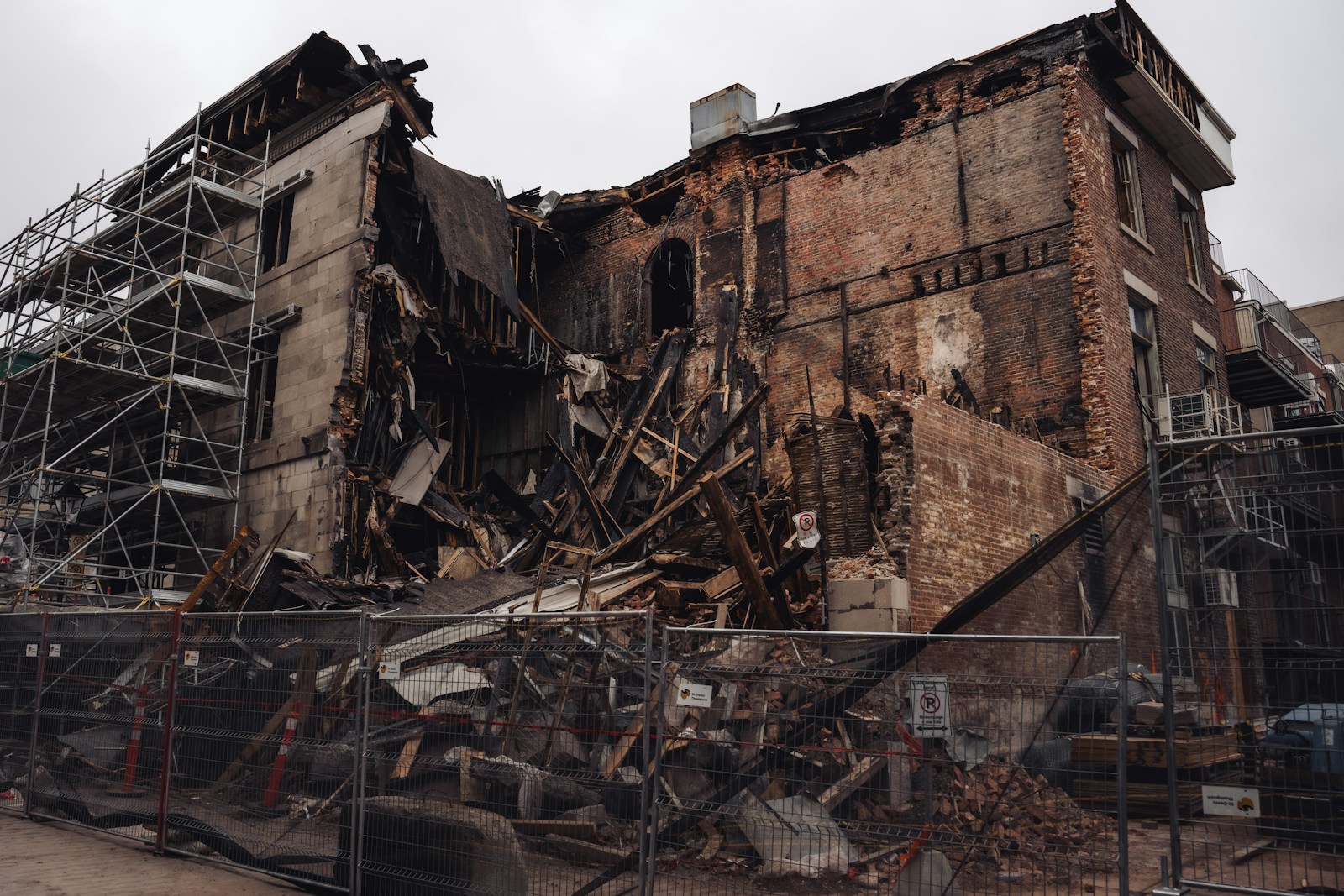
Coinsurance could mean you’ll be on the hook in a claim. If your building is insured for less than your policy requires, your insurer pays a fraction of the loss and you cover the difference.
Coinsurance, explained.
Coinsurance is a clause in most commercial property policies that requires you to insure a building for at least a set percentage of what it would cost to rebuild. Insure it for less and the insurer reduces every partial claim by the same proportion you fell short. It is a common reason a business owner receives far less than they expected on a claim they thought was fully covered.
Why insurers use it
Most claims are partial. A fire is contained to one section, a storm takes part of a roof, a pipe floods two floors. If insurers let everyone insure a $1,000,000 building for $300,000 and still collect in full on a $200,000 loss, the people who insured properly would be subsidizing the people who did not. The clause prices that fairly. Carry the required amount and you are paid in full, carry less and you are sharing the risk.
The formula
Every coinsurance calculation is the same three steps, and the clause is applied at the moment of loss, not when the policy was written.
- Work out what was required. Multiply the building’s replacement value by the coinsurance percentage. On a $1,000,000 building with an 80% clause, that is $800,000.
- Compare it to what you carried. If you insured for $600,000, the factor is $600,000 divided by $800,000, or 75%.
- Apply the factor to the claim. A $200,000 loss is paid at 75%, or $150,000, and your deductible comes off that. With a $5,000 deductible you receive $145,000 on a $200,000 loss.
The $55,000 difference is the coinsurance penalty, and no part of it is recoverable. It is worth sitting with that number:
- the building was insured,
- the fire was covered,
- the policy responded,
- and the owner still paid more than a quarter of the loss.
Carrying extra insurance does not earn you extra
The factor is capped at 100%. Insuring a $1,000,000 building for $1,200,000 under an 80% clause does not pay 150% of a claim, it pays 100% of it, and you paid premium on $200,000 of insurance that can never be collected. The target is to insure to value, not above it.
A total loss just uses the insured value
On a total loss the policy limit caps the payment before the clause matters. That $1,000,000 building insured for $600,000 burns to the ground and the owner receives $600,000, which is exactly the limit they bought.
How a limit falls behind without anyone noticing
Almost nobody sets out to be underinsured. The amount might have been right when the policy was written and then the world moved.
- Construction costs rose. Materials and labour have moved sharply in Alberta over the last several years. A limit set four years ago can be well short of today’s rebuilding cost without anyone touching the policy.
- The building changed. An addition, a finished mezzanine, an upgraded electrical service or a new roof all raise the replacement value. If the insurer was never told, the limit never moved.
- The value was guessed. Market value, the purchase price and the assessed value for property tax are all different from replacement cost, and in some markets the rebuilding cost is higher than the building would sell for.
- Building codes changed. Rebuilding to current code can cost more than putting back what was there, and by-law coverage is normally a separate item you have to buy to be covered.
What to do about it
- Talk the number through at renewal. Ask your broker what the building would cost to rebuild today, and how that compares to the limit on your policy.
- Report changes when they happen. Renovations, additions and changes of occupancy belong in a call to your broker, not in a note to raise at the next renewal.
- Ask about inflation protection. Indexing raises the amount of insurance through the term in line with a construction cost index, which slows the drift between reviews.
- Check the percentage you are on. Moving from a 100% clause to 80% lowers the bar you have to clear, and is sometimes the more practical fix on a building whose value is hard to pin down.
The one thing worth remembering
Coinsurance is checked at the time of loss, against the value at that moment. Nothing about last year’s valuation protects you.
Not sure what your policy says?
Send us your current policy and a licensed Alberta broker will read the coinsurance clause, check what your building is insured for, and tell you plainly whether you are exposed.